
Solving Multi-User Central Vacuum Challenges with a Modular Intelligent Distribution Box
Central vacuum systems are widely used in villas, hotels, office buildings, workshops, and commercial spaces. Compared with portable vacuum cleaners, a central vacuum system provides stronger suction, cleaner indoor air, lower operating noise, and a more convenient user experience.
However, when a central vacuum system is used by multiple users at the same time, the design becomes more challenging.
In a typical installation, many suction inlets may be distributed throughout the building. For example, a project may have 10, 20, or even more wall inlets. In practice, several users may want to open different suction points at the same time. This creates a key technical question:
How can the system maintain stable suction for multiple users without interference between branches?
The Challenge of Multi-User Central Vacuum Operation
In a simple central vacuum layout, multiple suction points are connected to one main pipe and one vacuum host. This works well when only one user operates the system at a time.
But when several suction ports are opened simultaneously, several problems may appear:
The suction pressure may drop suddenly.
One branch may take more airflow than another.
Users closer to the main pipe may get stronger suction than users farther away.
The vacuum host may not respond properly to changing load.
The system may become difficult to diagnose when one branch is blocked or leaking.
If multiple vacuum hosts are connected without proper control, there can also be airflow imbalance, backflow risk, and poor operating efficiency.
For this reason, a central vacuum system designed for multi-user operation needs more than simple pipe connection. It needs a proper distribution and control solution.
Why a Modular Distribution Box Is Worth Developing
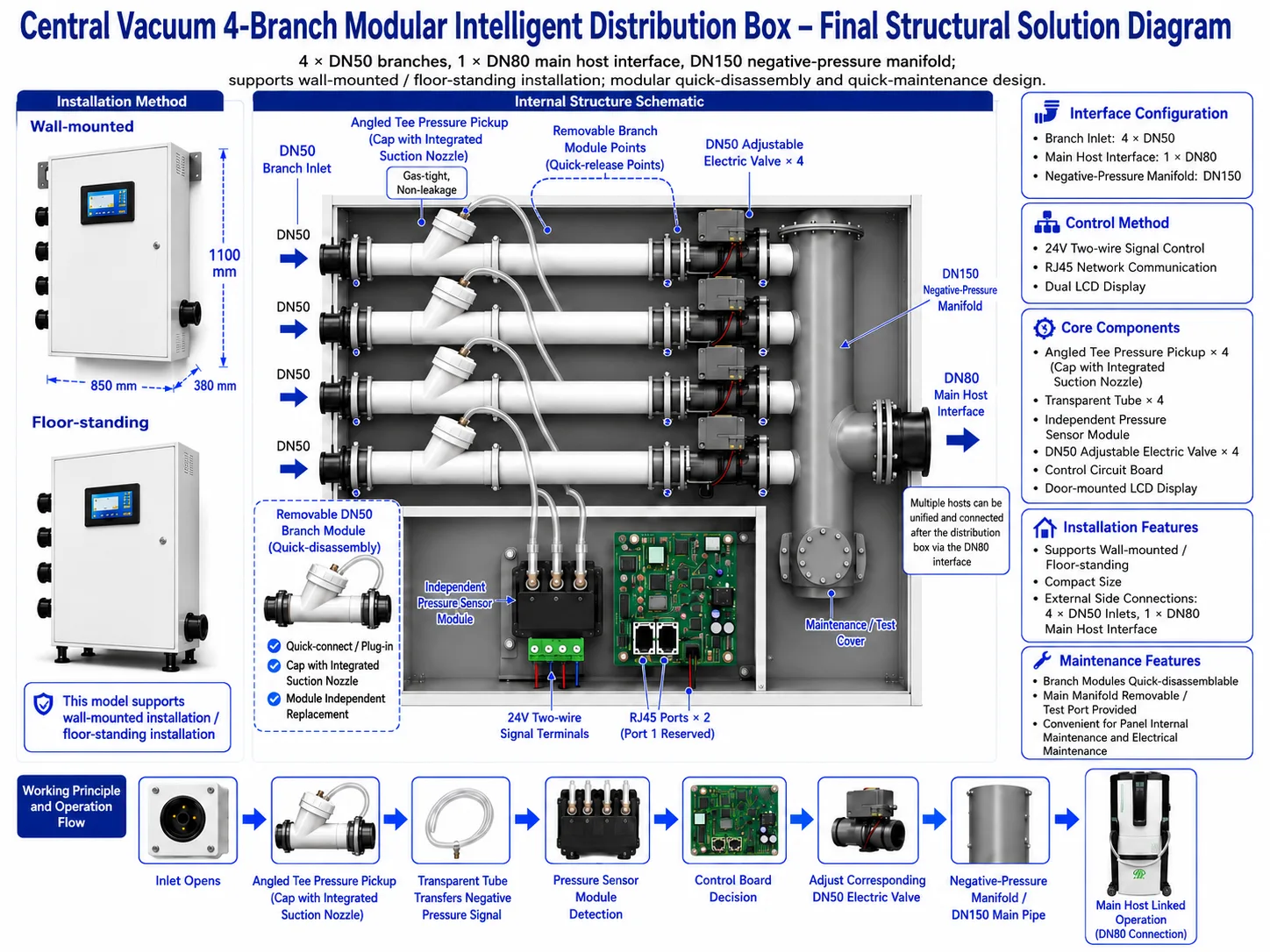
The 4-branch modular intelligent distribution box is designed to solve this problem in a more compact and serviceable way.
Instead of connecting many suction inlets directly into one uncontrolled manifold, the system divides the suction side into four controlled DN50 branches. Each branch has its own pressure pickup, transparent tube, pressure sensing path, and adjustable DN50 electric valve.
The four branches then merge into a DN150 negative-pressure manifold, and the host side connects through one DN80 main host interface.
This structure makes the system easier to control, easier to monitor, and easier to maintain.
Main Structural Concept
The distribution box is based on the following interface arrangement:
Branch side: 4 × DN50 suction branch inlets
Host side: 1 × DN80 main host interface
Internal manifold: DN150 negative-pressure manifold
Installation: wall-mounted or floor-standing
Control options: 24V two-wire signal control and RJ45 network communication
Maintenance: modular quick-disassembly design
One important design point is that the vacuum hosts are connected outside the box. If multiple home or commercial hosts are used, they are combined externally first and then connected to the distribution box through the DN80 main host interface.
This keeps the distribution box compact and avoids unnecessary internal host-side valves.
Branch Pressure Detection
Each DN50 branch uses an angled tee pressure pickup section. The main DN50 branch remains straight and horizontal, while the angled tee is installed on the branch in the correct airflow direction.
The cap of the angled tee includes a built-in suction nozzle. A transparent tube connects directly from this nozzle to an independent pressure sensor module.
This design has several advantages:
It avoids placing the pressure sensor directly inside the dusty main airflow.
It makes the pressure signal easier to transmit and monitor.
It reduces the risk of sensor contamination.
It allows the transparent tube to be inspected visually.
It makes maintenance easier for ordinary installers or electricians.
The angled tee must be installed in the correct direction. If installed backwards, airflow resistance, pressure signal accuracy, and dust accumulation may all be affected.
Adjustable DN50 Electric Valves
After the pressure pickup section, each branch passes through a DN50 adjustable electric valve.
The valve allows the system to control each branch independently. When a suction inlet is active, the corresponding branch can be opened or adjusted. When a branch is not needed, it can remain closed.
This helps reduce interference between branches and improves suction stability.
Independent Pressure Sensor Module
Instead of mounting pressure sensors directly on the main control PCB, the design uses an independent pressure sensor module.
This is important for maintenance.
If a pressure sensor fails, the sensor module can be inspected or replaced without changing the entire control board. The transparent tubes can also be checked or replaced more easily.
The main control board receives the pressure signal, evaluates branch status, and controls the corresponding DN50 electric valves.
Modular Maintenance Design
One of the most important goals of this design is serviceability.
Central vacuum systems may be used in environments where dust, paper scraps, small debris, or other materials can enter the pipeline. Blockage is always a possibility.
The distribution box should therefore be designed with quick maintenance in mind.
The DN50 branch modules should include quick-connect or plug-in structures. Each branch module should be removable for cleaning, inspection, or replacement. The DN150 manifold should also include a maintenance or test cover for cleaning and inspection.
The maintenance target is simple:
No need to remove the whole cabinet.
No need to break the wall.
No need to cut external pipes.
A regular technician or electrician should be able to open the panel, locate the problem branch, remove the branch module, clean it, and reinstall it.
Wall-Mounted or Floor-Standing Installation
Because many central vacuum hosts are wall-mounted, the distribution box should also support wall-mounted installation where possible.
At the same time, for some commercial projects or heavier configurations, a floor-standing installation may be more practical.
Therefore, the same model can support both:
Wall-mounted installation for compact equipment rooms or residential systems.
Floor-standing installation for commercial or maintenance-friendly applications.
A compact size such as approximately 850 mm wide, 1100 mm high, and 380 mm deep gives enough internal space for DN50 branches, the DN150 manifold, pressure tubes, valves, control electronics, and maintenance access.
A Promising Direction for Central Vacuum Systems
Multi-user central vacuum operation is a real challenge, especially in buildings where several people may use suction inlets at the same time.
A modular intelligent distribution box by SYDMAY provides a practical path forward. It helps divide the system into controllable branches, monitor each branch independently, regulate branch airflow, and simplify maintenance.
This type of product is not just an accessory. It can become a key control component in future central vacuum systems.
As central vacuum applications expand from single-family homes to villas, hotels, offices, workshops, and commercial buildings, reliable multi-user operation will become more important. A compact, modular, serviceable distribution box of SYDMAY is therefore a field worth exploring and developing further.